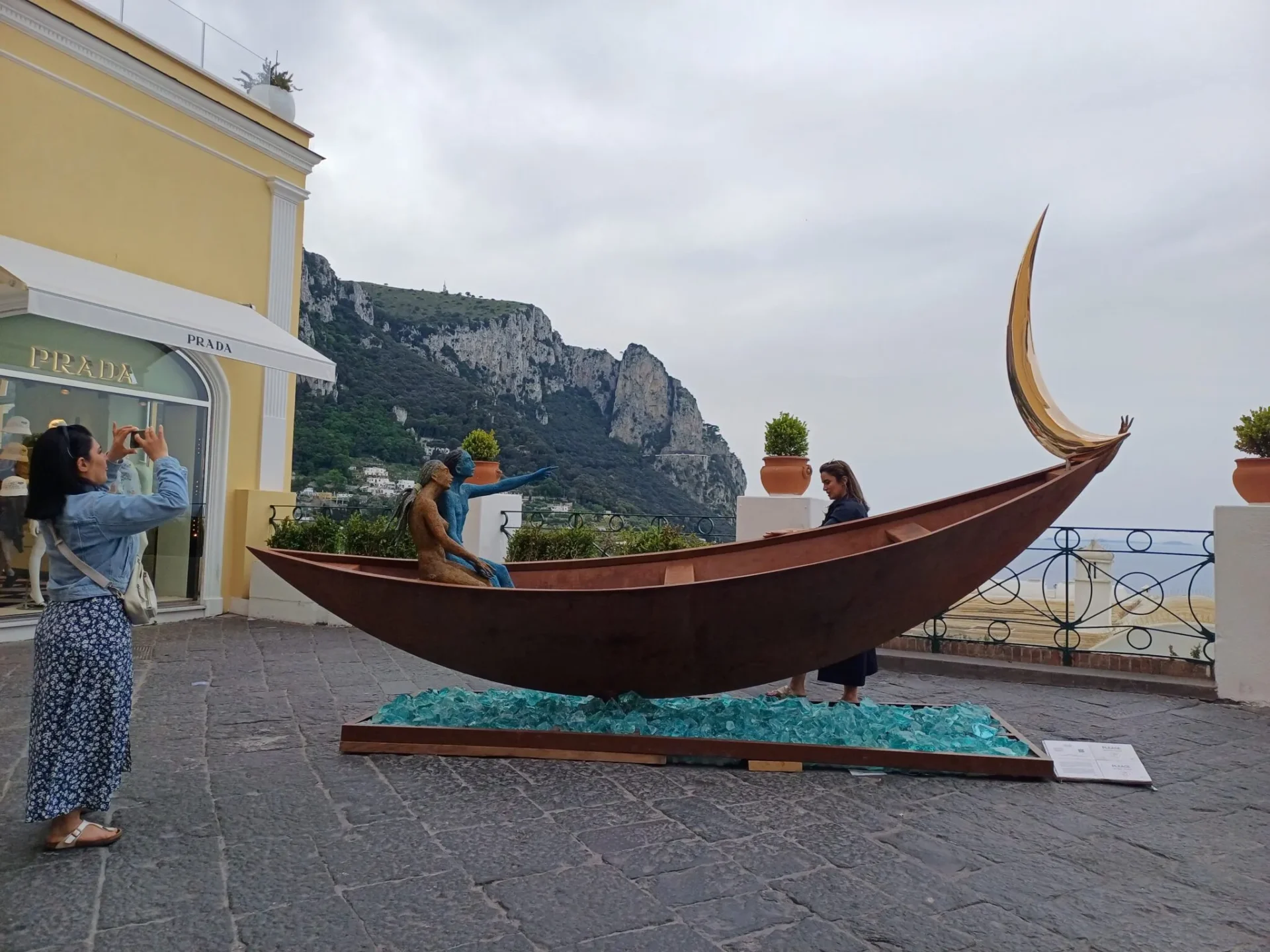


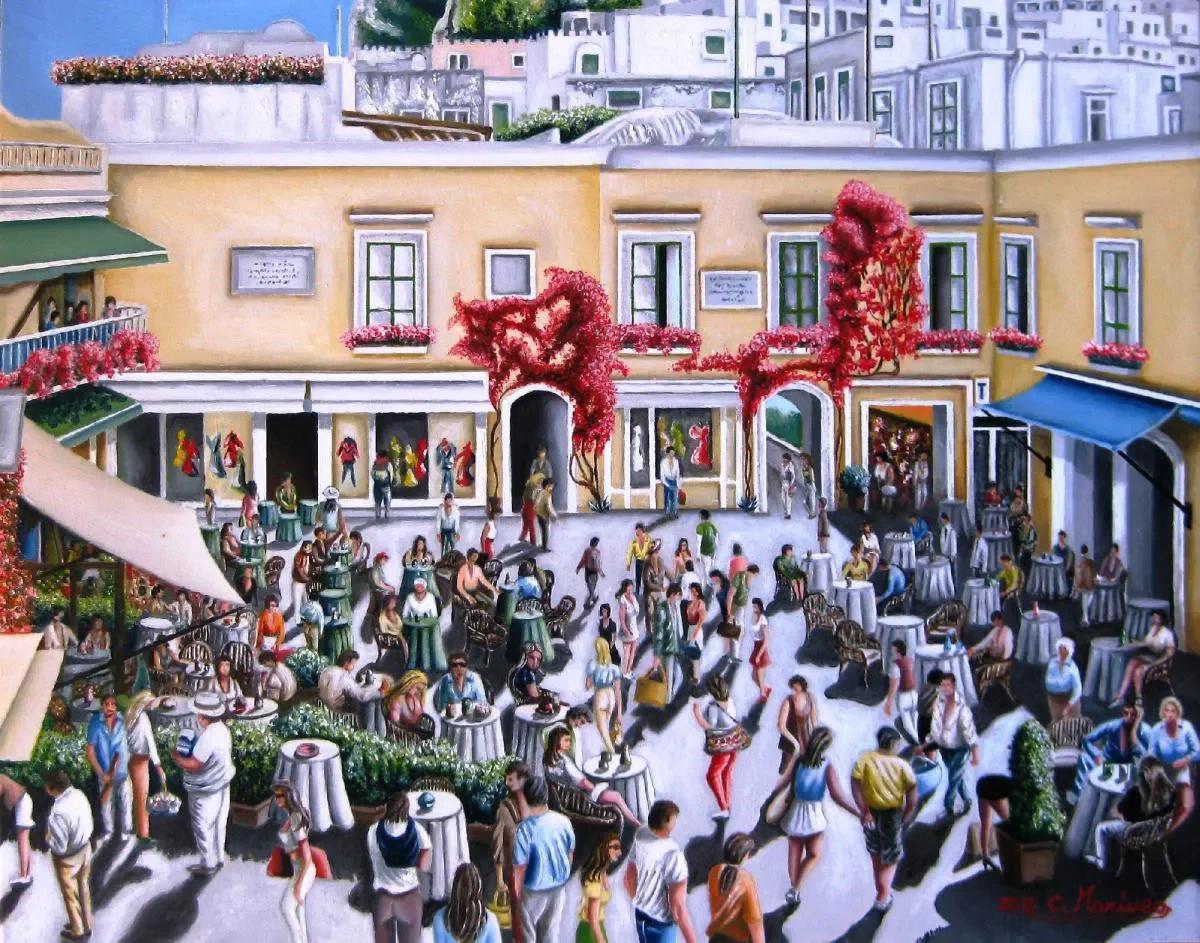
“A small market, which starts from the cathedral and ends at the customs house, is Capri’s market, where beans and some fruits are sold, sometimes macarons, but meat almost never. If by misfortune a cow falls from a rock, and remains dead, it is published with the trumpet throughout the island that will sell meat”. Thus, at the end of 1700, the Austrian historian Norbert Hadrawa described the small square of Capri. This square was once, for a long time, the home of the local market where they sold fruit and vegetables and fish.
The square changed completely in the nineteenth century, when the first road was built on the island and the first public pharmacy was opened (“la Strada Nuova”, now via Roma in honor of the new capital of Italy).
In 1877-78, the road to Marina Grande was completed and a tree-lined shelter for the carriages was built.
On the threshold of the 20th century, the square became the heart of the tourist Capri.
In 1900 the square, until then anonymous, was named after Umberto I of Italy, the king who had just died, thus officially becoming “Piazza Umberto I”. In 1907, instead, the funicular of Capri was inaugurated, the cable system that connected the square to the village of Marina Grande.
The square took on a more mundane character only when Raffaele Vuotto, between 1934 and 1938, opened his bar, the “Gran Caffè Vuotto”.
After the opening of the latter other capresi followed it by opening their own activities and from that moment the Piazzetta has become the heart of the social life of the island.
But this space already had its future written, a magical destiny that would project the entire island outside the perimeter intended by the sea, a space that would take the name, therefore, of “Salon of the world”. In the open space, in fact, on that unmistakable pavement made of lava stone, would have stopped practically everyone: from the most dispersed tourists to characters of all kinds and of every rank. No one would have just passed without stopping to refuel, to listen to the beating heart of the island or just to admire the part that looks north, from Solaro to the Gulf of Naples with Ischia, Procida and Naples placed in Honor Tribune to watch Capri.
The square, therefore, has not only become a meeting place like any other typical square: it is the life of the island, its very identity that shows the mood of an entire country: parties, funerals, frantic work or strolling holiday, Worldliness or sleep, in that space there is the beat of a heart that refers to everything else.
And the lifestyle that we identify with “Fashion Capri”, that essence made of people and traditions, beauty and elegance, conquers its “mark of origin” right here: from the Piazzetta, in fact, stand as in the window a thousand strong symbols that recall an identity, that “fashion” that becomes international, “of the world”, thanks to those who stop and who throws it in a thousand ways off the island (from the ancient images of the past to the selfies and movies of today). Just stop a few hours, at different times of the day and seasons, to have all the knowledge of a unique style.
“Salon of the world” because projected everywhere, “salon of the world” because anyone from anywhere passes through here, tasting, imitating or being part of this small symbolic universe.
“Salon of the world” that baptizes this site which, with sobriety, lightness and elegance, aims to tell the island in all its most representative aspects that contain the charm of Capri already in its own name.
(Photo: Piazzetta di Capri, Oil on canvas, 2013 – Claudio Marineo painter)